
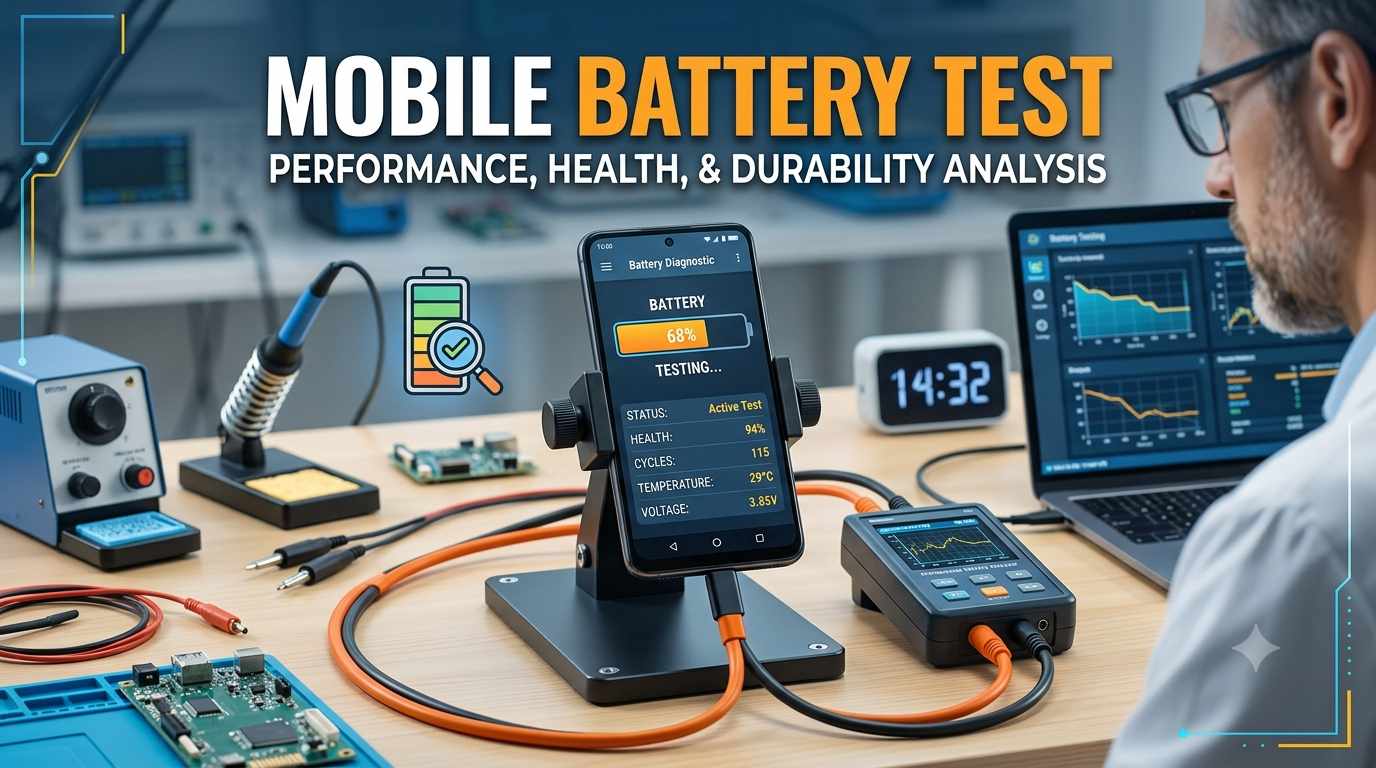
Introduction About Mobile Battery Test
Most of us—whether living in India or residing in Kuwait—tend to focus solely on megapixels and RAM when buying a phone, but the real game lies in the battery. There is often a world of difference between paper claims and real-life performance—especially in countries like Kuwait, where outdoor temperatures soar very high. Therefore, today we will discuss in depth how a proper Mobile Battery Test is conducted and how you can discover the true capability of your phone yourself.
What is a Mobile Battery Test?
When reviewing phones in Kuwait for the first time, the initial assumption was that testing a battery simply involved charging it to 100% in the morning and monitoring it until evening inside an air-conditioned room. However, reality is quite different.
A Mobile Battery Test is a systematic and practical method used to evaluate how long a smartphone genuinely lasts under continuous usage. This assessment goes beyond measuring mere hours of runtime; it inspects how rapidly battery drain occurs during outdoor use under Kuwait’s high temperatures, heavy gaming, camera sessions, and media consumption, while also checking for potential Screen-On Time (SOT) drops and thermal throttling issues.
How to Test Mobile Battery Performance in Kuwait
To accurately evaluate a phone’s battery performance, following a structured procedure is essential. For reliable results, standard testing parameters are implemented as follows:
- Full Charging: First, charge the phone to 100% (ensuring the battery is fully calibrated).
- Display Settings: Set brightness to approximately 50% or auto mode (factoring in how ambient light sensors automatically boost brightness under intense sunlight) and lock the refresh rate at either 60Hz or 120Hz.
- Connectivity: Connect to a stable Wi-Fi network or reliable local cellular coverage options such as Zain, Ooredoo, or STC 5G networks.
- Background Apps: Clear all background tasks to minimize unintended power draw.
The parameters evaluated during standard diagnostic tests can be reviewed in the table below:
| Test Name | Objective | Average Benchmark |
|---|---|---|
| Video Playback | Evaluates normal usage and media consumption efficiency | 12 to 16 hours (on Wi-Fi) |
| Gaming Test | Assesses high-performance load capacity and thermal behavior | 4 to 6 hours (Continuous) |
| Standby Test | Measures overnight idle battery drainage | 2% to 5% drop (over 8 hours) |
Real-Time Mobile Battery Drain Test

Life in Kuwait moves at a fast pace—people frequently rely on Google Maps, social media, and continuous calling while commuting by car. Evaluating phones across diverse conditions remains essential, as true battery backup cannot be determined without putting devices through real-world scenarios.
100% to 0% Battery Drain Test
This serves as the most fundamental and popular evaluation method. The phone is charged to 100% and utilized continuously until it shuts down automatically, providing an accurate estimation of total Screen-On-Time (SOT).
YouTube Video Playback Battery Test
Running Full HD videos continuously helps clarify power consumption rates by the display panel and video decoder processor during media streaming sessions.
Gaming Battery Test (BGMI / PUBG)
Heavy gaming acts as a primary battery consumer. Many youth in Kuwait enjoy gaming during evening hours. Running demanding titles like BGMI or Genshin Impact pushes both the Central Processing Unit (CPU) and Graphics Processing Unit (GPU) to full capacity, causing rapid battery drain under elevated ambient temperatures.
Camera Recording Battery Test
Recording 4K video continuously at popular landmarks in Kuwait, such as the Kuwait Towers or The Avenues Mall, acts as an ideal benchmark for evaluating thermal management. This activity increases the load on the Image Signal Processor (ISP), leading to device heating and accelerated battery depletion.
Standby Battery Test
Leaving the device fully charged before sleep and checking it upon waking reveals idle performance. A drop exceeding 10% indicates potential issues with wake-locks or background synchronization.
Mobile Battery Test Results Table
Based on practical evaluations and testing various smartphones under demanding regional environments like Kuwait, a precise comparative breakdown is outlined below:
| Usage Type | Battery Drain Rate | Phone Behavior |
|---|---|---|
| General Scrolling / Chatting | Very slow (approx. 5-6% per hour) | Device temperature remains completely normal |
| Online Video Streaming | Moderate (approx. 8-10% per hour) | Slight warmth may be felt |
| Heavy Gaming (BGMI) | Very fast (approx. 18-22% per hour) | Device heats up and battery drops rapidly |
| Camera Video Recording | High (approx. 15-20% per hour) | Maximum stress is placed on the battery and processor |
Best Battery Backup Phones in 2026
Across local retail markets—whether browsing through stores in Hawally or Fahaheel, or exploring digital platforms like Lulu Hypermarket—smartphones featuring long battery lives ranging from 5000mAh to 6000mAh capacity remain in highest demand this year.
Since users frequently remain outdoors under intense sunlight requiring consistently high display brightness levels due to ambient lighting adjustments, devices packed with large power capacities and modern energy-efficient chipsets are essential to ensure dependable daily endurance.
Mobile Battery Charging Speed Test
Possessing a large battery capacity alone is not enough. Fast-paced lifestyles mean that individuals rarely have the luxury of leaving their phones plugged in for hours. Modern fast-charging technologies (such as 67W, 120W, and higher) paired with lithium-ion batteries are specifically engineered to ensure rapid replenishment while maintaining safety standards. Consequently, evaluating charging speed has become just as critical as conducting a comprehensive mobile battery test.
How to Check Mobile Battery Health
Many users frequently inquire about monitoring device health amidst regional heat conditions affecting power endurance, making it essential to understand how to check battery health accurately.
For Android devices, checking the dedicated ‘Battery & Device Care’ section within settings or utilizing verified diagnostic tools like AccuBattery provides precise insights into battery wear levels.
For iPhone users, the process is streamlined by navigating directly to Settings > Battery > Battery Health & Charging to review the maximum capacity percentage. If this figure drops below 80%, replacement should be considered to maintain reliable daily performance.
Why Does Mobile Battery Drain Fast?
Rapid battery depletion in regional environments like Kuwait is often driven by specific technical and environmental factors:
- Ambient Heat & Thermal Stress: The ideal operating temperature for lithium-ion batteries typically ranges between 20°C and 35°C. Intense external heat accelerates chemical reactions inside the cell, reducing overall battery efficiency and longevity.
- Weak Network Signal: Inside basement parking structures or heavy concrete buildings, frequent signal drops force the internal modem to continuously search for towers, consuming significant power and accelerating battery drainage.
- High Screen Brightness: Relying on maximum manual brightness or auto-boost features under bright sunlight causes the display panel to draw the highest share of system power.
Tips to Improve Mobile Battery Life
To maintain optimal battery health and extend daily endurance under demanding regional conditions, implementing a few essential care practices is recommended:
- Avoid leaving the smartphone directly exposed to intense sunlight or on a closed vehicle dashboard, as excessive thermal exposure poses a risk of permanent battery degradation.
- Prevent the battery level from completely depleting to 0%; plugging the device into a charger when capacity drops to around 15% to 20% helps preserve long-term cell health.
- Utilize stable Wi-Fi connectivity indoors and disable features like GPS or Bluetooth when not actively required during commutes.
FAQs About Mobile Battery Test
Q1: Does regional heat really degrade phone batteries faster?
Ans: Yes, extreme ambient temperatures serve as a major factor affecting lithium-ion battery lifespans. Elevated heat accelerates internal chemical degradation processes over time.
Q2: Does overnight charging damage the phone battery?
Ans: Modern smartphones incorporate built-in ‘Optimized Battery Charging’ and smart power management chips that automatically halt current flow once 100% capacity is reached. However, disconnecting the charger after a full charge remains a good practice for preserving long-term cell longevity.
Q3: Does using a fast charger wear out the battery quickly?
Ans: When utilizing certified original fast chargers and compatible cables provided by the manufacturer, integrated thermal management systems protect the battery, preventing significant harm during high-speed replenishment.
Mobile Battery Test Final Conclusion
Ultimately, all residents and users in regional environments like Kuwait must note that local weather patterns and fast-paced lifestyles require mindful gadget care. Every comprehensive mobile battery test demonstrates that endurance relies heavily not just on raw hardware specifications, but also on individual usage habits and environmental conditions.
Disclaimer
The technical insights and data provided in this article are based on general research and practical experiences. Battery performance may vary across different smartphone models and brands due to distinct software optimization procedures.